

Demand Submission
Please leave us a message and we will contact you within 24 hours
NEWS CENTER
A variety of production processes, research and development, production, sales integration
NEWS CENTER
A variety of production processes, research and development, production, sales integration
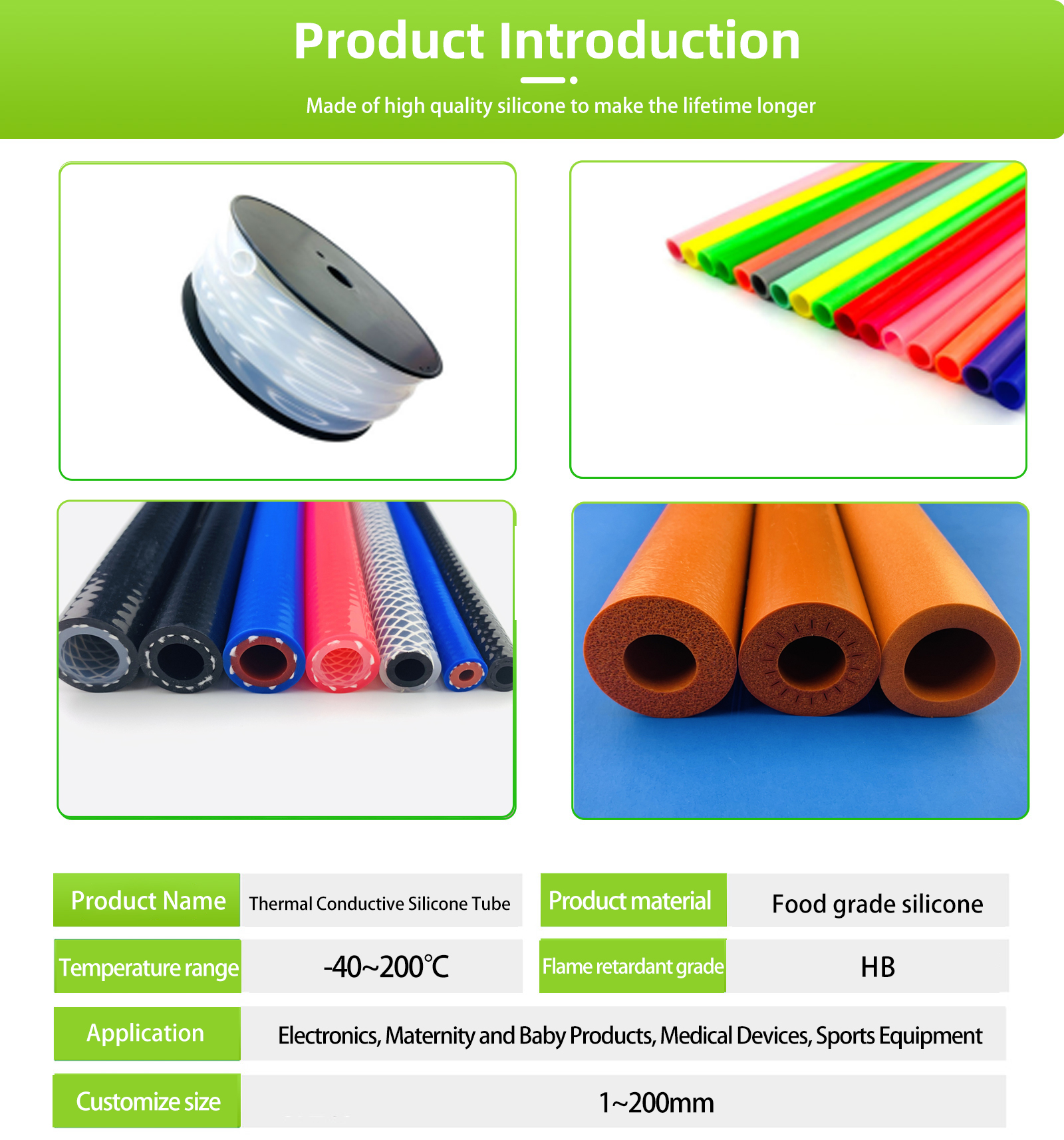
Thermal Conductive Silicone Tubing for Industrial Heat Management Applications
Time: 2026-02-26 09:17:17
Author: Dongguan Yutian Silicone Rubber Technology Co., Lt
Click:
Thermal conductive silicone tubing improves heat transfer efficiency in industrial systems by incorporating aluminum oxide fillers to achieve up to 1.4 W/m·K conductivity. Designed for high-temperature stability and mechanical durability, it is ideal for battery cooling, electronics thermal management, and heat-sensitive equipment applications.
Conventional silicone tubing is widely used for flexibility, chemical resistance, and high-temperature stability. However, standard silicone typically has low thermal conductivity (around 0.2 W/m·K), limiting its ability to dissipate heat efficiently in demanding industrial systems.
Thermal conductive silicone tubing enhances heat transfer performance by incorporating thermally conductive fillers, making it suitable for battery systems, electronics cooling, and industrial thermal management applications.
Engineering Principle of Thermal Conductive Silicone Tubing
Thermal conductive silicone tubing is manufactured by integrating high-purity aluminum oxide (Al₂O₃) fillers into the silicone matrix. Through optimized compounding and extrusion control, the material can achieve thermal conductivity up to:
1.4 W/m·K
Proper filler dispersion is essential to create stable thermal conduction pathways while preserving elasticity and mechanical integrity.
Key Technical Advantages
Improved Heat Dissipation
By increasing thermal conductivity, the tubing accelerates heat transfer from internal fluids or surrounding components, helping maintain stable operating temperatures in compact systems.
Wide Operating Temperature Range
Thermal conductive silicone tubing maintains stable performance within a typical temperature range of:
-40°C to 200°C
High-temperature formulations may support even broader ranges depending on application requirements.
Electrical Insulation with Thermal Transfer
Unlike metallic heat transfer components, silicone remains electrically insulating while offering enhanced thermal conductivity. This makes it suitable for applications requiring both thermal management and electrical isolation.
Long-Term Aging and Environmental Resistance
The material retains resistance to UV radiation, ozone, moisture, oxidation, and mild chemicals. This ensures stable thermal and mechanical performance in long-term industrial operation.
Typical Application Areas
Battery Thermal Management Systems
In lithium battery modules and energy storage systems, heat accumulation can affect safety and lifespan. Thermal conductive silicone tubing supports improved heat dissipation while safely transporting coolant or air.
Power Electronics and Inverters
Compact power modules generate significant localized heat. Thermal conductive tubing assists in transferring heat away from sensitive components without compromising flexibility.
Industrial Fluid Heating and Cooling Systems
In heated oil lines or temperature-controlled processing systems, heat transfer silicone tubing improves thermal exchange efficiency compared to conventional silicone hoses.
Engineering Selection Considerations
When selecting thermal conductive silicone tubing, engineers and procurement teams should evaluate:
• Thermal conductivity rating (W/m·K)
• Wall thickness and dimensional tolerance
• Mechanical strength at operating temperature
• Compression set performance
• Long-term aging stability
• Consistency of filler dispersion
Reliable extrusion quality and batch stability are critical for OEM projects and continuous industrial production.
Conclusion
Thermal conductive silicone tubing bridges flexibility and effective heat transfer in modern industrial systems. With conductivity reaching up to 1.4 W/m·K through optimized aluminum oxide filling technology, it provides a practical solution for applications where temperature control directly impacts performance and reliability.
For engineers seeking stable thermal performance combined with silicone durability, selecting a properly engineered thermal conductive formulation is a strategic design decision.

点击右上角
分享给朋友吧







 Long by picture save/share
0
Popular
-
top Colored Silicone Tube: Production Process and How to Choose
-
top Enhancing the Lifespan of High-Temperature Silicone Tubes in...
-
top Introducing the Innovative Foam Silicone Tube: A High-Perfor...
-
The evolution and future of silicone material: a panoramic a...
-
Dongguan Yutian Silicone Rubber Technology Co., Ltd. Unveils...
-
Understanding the Causes of Bending and Clogging in Food-Gra...
-
Explore Cutting-Edge Silicone Solutions with Dongguan Yutian...
-
Dongguan Yutian Successfully Showcases Innovative Medical Si...
Latest Products








Message
Hi!If you are looking for custom-made silicone rubber products, feel free to ask me any questions.
Thermal Conductive Silicone Tubing for Industrial Heat Management Applications
Author:Dongguan Yutian Silicone Rubber Technology Co., Lt
Click:
Time:2026-02-26 09:17:17
Conventional silicone tubing is widely used for flexibility, chemical resistance, and high-temperature stability. However, standard silicone typically has low thermal conductivity (around 0.2 W/m·K), limiting its ability to dissipate heat efficiently in demanding industrial systems.
Thermal conductive silicone tubing enhances heat transfer performance by incorporating thermally conductive fillers, making it suitable for battery systems, electronics cooling, and industrial thermal management applications.
Engineering Principle of Thermal Conductive Silicone Tubing
Thermal conductive silicone tubing is manufactured by integrating high-purity aluminum oxide (Al₂O₃) fillers into the silicone matrix. Through optimized compounding and extrusion control, the material can achieve thermal conductivity up to:
1.4 W/m·K
Proper filler dispersion is essential to create stable thermal conduction pathways while preserving elasticity and mechanical integrity.
Key Technical Advantages
Improved Heat Dissipation
By increasing thermal conductivity, the tubing accelerates heat transfer from internal fluids or surrounding components, helping maintain stable operating temperatures in compact systems.
Wide Operating Temperature Range
Thermal conductive silicone tubing maintains stable performance within a typical temperature range of:
-40°C to 200°C
High-temperature formulations may support even broader ranges depending on application requirements.
Electrical Insulation with Thermal Transfer
Unlike metallic heat transfer components, silicone remains electrically insulating while offering enhanced thermal conductivity. This makes it suitable for applications requiring both thermal management and electrical isolation.
Long-Term Aging and Environmental Resistance
The material retains resistance to UV radiation, ozone, moisture, oxidation, and mild chemicals. This ensures stable thermal and mechanical performance in long-term industrial operation.
Typical Application Areas
Battery Thermal Management Systems
In lithium battery modules and energy storage systems, heat accumulation can affect safety and lifespan. Thermal conductive silicone tubing supports improved heat dissipation while safely transporting coolant or air.
Power Electronics and Inverters
Compact power modules generate significant localized heat. Thermal conductive tubing assists in transferring heat away from sensitive components without compromising flexibility.
Industrial Fluid Heating and Cooling Systems
In heated oil lines or temperature-controlled processing systems, heat transfer silicone tubing improves thermal exchange efficiency compared to conventional silicone hoses.
Engineering Selection Considerations
When selecting thermal conductive silicone tubing, engineers and procurement teams should evaluate:
• Thermal conductivity rating (W/m·K)
• Wall thickness and dimensional tolerance
• Mechanical strength at operating temperature
• Compression set performance
• Long-term aging stability
• Consistency of filler dispersion
Reliable extrusion quality and batch stability are critical for OEM projects and continuous industrial production.
Conclusion
Thermal conductive silicone tubing bridges flexibility and effective heat transfer in modern industrial systems. With conductivity reaching up to 1.4 W/m·K through optimized aluminum oxide filling technology, it provides a practical solution for applications where temperature control directly impacts performance and reliability.
For engineers seeking stable thermal performance combined with silicone durability, selecting a properly engineered thermal conductive formulation is a strategic design decision.
点击右上角
分享给朋友吧
Long by picture save/share
0
Popular
Popular
Popular
Popular
-
top Colored Silicone Tube: Production Process and How to Choose
-
top Enhancing the Lifespan of High-Temperature Silicone Tubes in...
-
top Introducing the Innovative Foam Silicone Tube: A High-Perfor...
-
The evolution and future of silicone material: a panoramic a...
-
Dongguan Yutian Silicone Rubber Technology Co., Ltd. Unveils...
-
Understanding the Causes of Bending and Clogging in Food-Gra...
-
Explore Cutting-Edge Silicone Solutions with Dongguan Yutian...
-
Dongguan Yutian Successfully Showcases Innovative Medical Si...
Latest Products
Message
 Brown Di
 Brown Di